
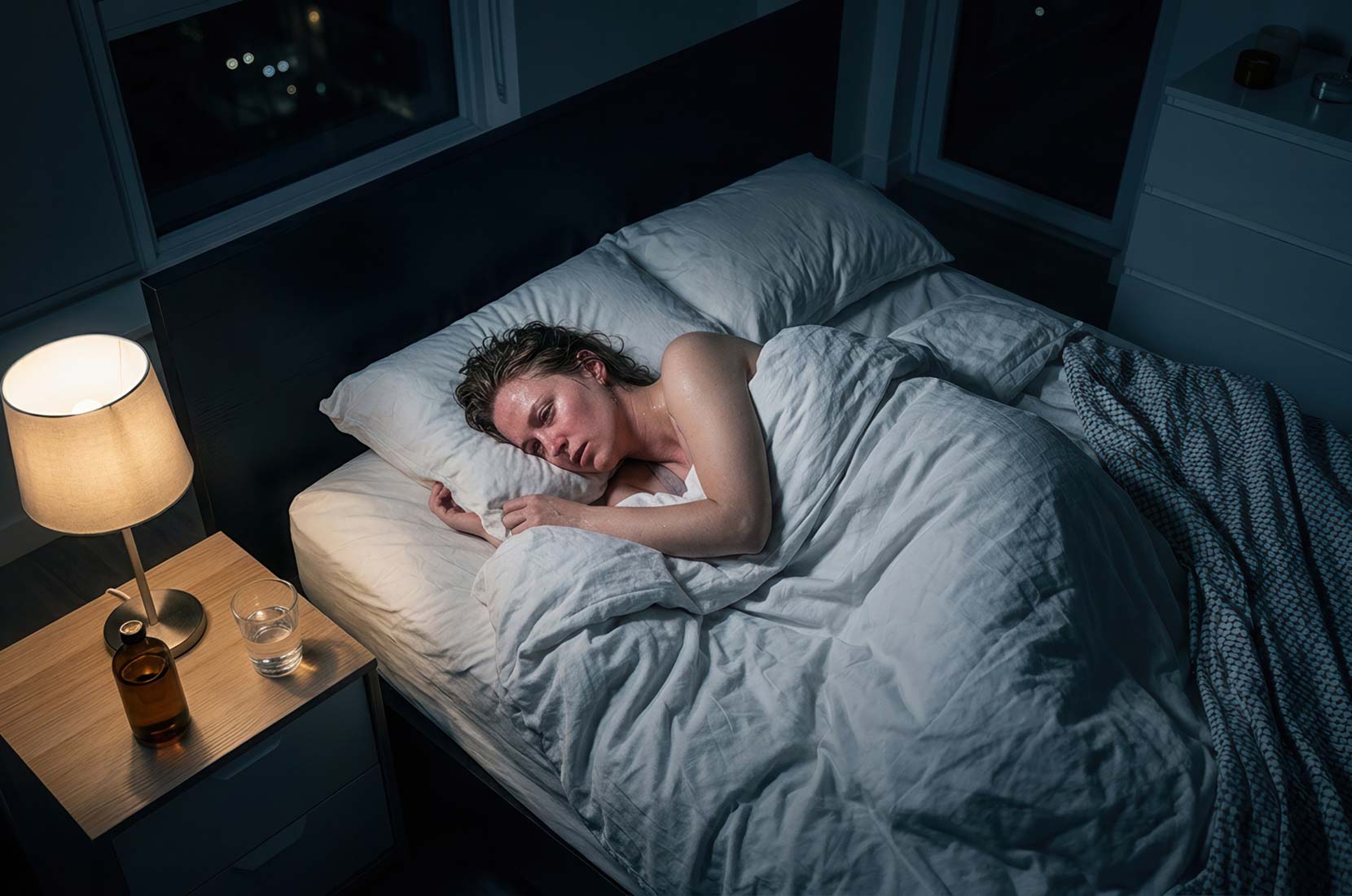
You wake up and something is wrong.
The sheets are damp. Your clothes are clinging to you. You throw off the covers, maybe get up to change, maybe just lie there on top of the blankets waiting for your body to cool down. Eventually it does. You drift back to sleep. And then it happens again.
This is not an occasional thing. It is a pattern. Waking up drenched in sweat, soaking the sheets, more than once a week, sometimes more than once a night. You are exhausted and frustrated and you have probably started sleeping on a towel or keeping a spare set of clothes on the nightstand.
If this is your life right now, you are not imagining it. And you do not have to keep living it.
Night sweats are one of the most common early signs of perimenopause and hormonal decline. And the reason they happen comes down to one hormone that tends to drop before most women even realize anything has changed.
Women's hormones usually start declining in the mid to late 30s, and that decline picks up through the 40s. Progesterone is typically the first hormone to slide. And when progesterone drops, night sweats are often one of the first things that follow.
That is the short version. No complicated endocrinology. No lengthy explanation of your thermoregulation system. Your progesterone is lower than it used to be, and your body is telling you about it at two in the morning.
The assumption most women make is some version of: this is just what my body does now. I have to ride it out.
It makes sense that you would think that. Night sweats get lumped in with all the other things that are supposed to be "normal" after a certain age, the things you are told to expect and accept and manage as best you can. So you buy the moisture-wicking sheets. You turn the thermostat down. You tell yourself it is probably stress.
But night sweats are not a fact of life. They are a symptom. A specific hormonal symptom with a specific hormonal cause. And that matters, because symptoms with causes have solutions. You are not just getting older in a general way. Your progesterone is shifting, and that shift is addressable.
This is not something you have to endure. It is something that can usually be fixed, and faster than most women expect.
Here is the part that tends to surprise people.
When progesterone is replaced, the night sweats typically resolve within about a week. Not months. Not a long adjustment period. Only about a week.
Dr. Adams calls this instant gratification, because in the world of hormonal health, a result that comes that quickly is genuinely unusual. The cause is identifiable. The fix is known. The timeline is short. A little progesterone replacement, and the body tends to settle back into a rhythm that does not involve waking up soaked at 3 in the morning.
That is not a promise of a specific outcome for every person. Bodies vary, and "typically" is doing real work in that sentence. But for most women living this pattern, the fix is closer than they think. This is not a years-long process. It is, in most cases, a matter of weeks.
And when the nights get better, everything else starts to follow. Sleep that actually restores you tends to do a world of good for the rest of your life.
If you have been waking up soaked more nights than not, and you have been telling yourself this is just how things are now, there is one question worth asking the next time you talk to your doctor.
Has your progesterone been looked at?
Because if your progesterone is low, that is a real answer to a real problem. And a real answer is worth having.
You do not have to keep waking up drenched in sweat and telling yourself it is "normal." There is a reason this is happening, and for most women, there is something that actually helps.
That is worth asking about.